Erlang B (loss systems)
In Erlang C and Erlang A, customers who arrive when all agents are busy wait in a queue. In some systems there is no waiting room at all: if every channel or trunk is occupied the call is rejected immediately and the customer must try again later. The Erlang B model (the M/M/c/c queue) describes these pure-loss systems.
When to use Erlang B
| Use case | Why Erlang B fits |
|---|---|
| PSTN / SIP trunk sizing | Calls are blocked at the network, not queued |
| IVR / auto-attendant channel capacity | Channels are finite; no hold queue |
| Overflow link sizing in skill-based routing | Overflow is discarded, not retried internally |
| Any blocked-calls-cleared operation | Excess demand is shed, not absorbed |
If your system does queue callers, use Erlang C (infinite patience) or Erlang A (finite patience) instead.
The model
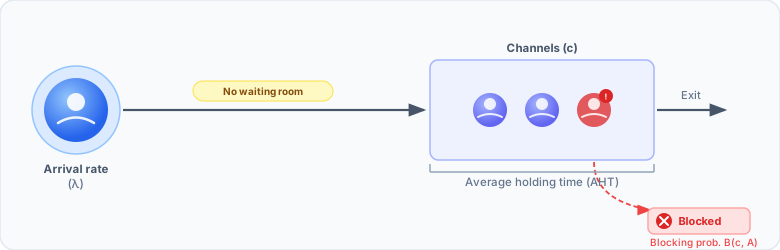
Erlang B (M/M/c/c) makes three assumptions:
- arrivals follow a Poisson process;
- each call occupies exactly one trunk / channel for an exponentially distributed holding time;
- there are exactly c channels and no waiting room — a call that finds all c channels busy is blocked and lost.
The blocking probability is computed via the numerically stable recursion:
$$B(0, A) = 1 \qquad B(n, A) = \frac{A \cdot B(n-1, A)}{n + A \cdot B(n-1, A)}$$
where $A = \text{transactions} / \text{interval} \times \text{AHT}$ is the offered traffic in Erlangs.
Unlike Erlang C, the Erlang B system is stable for any load — excess traffic is simply blocked rather than allowed to grow the queue.
Basic usage
from pyworkforce.queuing import ErlangB

erlang = ErlangB(transactions=100, aht=3, interval=30, shrinkage=0.3)

result = erlang.required_positions(max_blocking=0.02)
print(result){'raw_positions': 17,
'positions': 25,
'blocking_probability': 0.0183...,
'occupancy': 0.937...}Units
aht and interval must use the same time unit (both minutes in the example above).
What the result means
raw_positions— the minimum number of productive channels needed to stay within themax_blockingtarget.positions— channels after accounting for shrinkage:ceil(raw_positions / (1 − shrinkage)).blocking_probability— the achieved blocking probability atraw_positions.occupancy— expected fraction of busy channels (carried traffic / channels).
Adding an occupancy cap
Pass max_occupancy to reject solutions where servers are overloaded even if the blocking target is met:
result = erlang.required_positions(max_blocking=0.02, max_occupancy=0.85)Evaluating a fixed number of channels
You can also assess performance for a known number of channels rather than sizing from scratch:
erlang.blocking_probability(positions=20)   # probability a call is blocked
erlang.achieved_occupancy(positions=20)     # server utilisation
If your positions figure already includes shrinkage, pass scale_positions=True:
erlang.blocking_probability(positions=25, scale_positions=True)Parameters
| Parameter | Meaning |
|---|---|
transactions | Calls (or tasks) arriving in the interval |
aht | Average holding time per call |
interval | Interval length (same unit as aht) |
shrinkage | Fraction of unavailable time, in [0, 1) |
ErlangB does not take an asa parameter because there is no waiting in this model.
Running many scenarios with MultiErlangB
MultiErlangB sweeps a parameter grid in parallel, exactly like MultiErlangC:
from pyworkforce.queuing import MultiErlangB
from pyworkforce.utils import results_to_dataframe

param_grid = {
    "transactions": [80, 100, 120],
    "aht": [3],
    "interval": [30],
    "shrinkage": [0.0],
}
multi = MultiErlangB(param_grid=param_grid, n_jobs=-1)

scenarios = {"max_blocking": [0.01, 0.02]}
results = multi.required_positions(scenarios)

df = results_to_dataframe(results, multi.required_positions_params)
print(df[["transactions", "max_blocking", "raw_positions", "blocking_probability"]].to_string(index=False)) transactions max_blocking raw_positions blocking_probability
80 0.01 14 0.0098...
80 0.02 13 0.0190...
100 0.01 17 0.0095...
100 0.02 17 0.0095...
120 0.01 20 0.0099...
120 0.02 19 0.0191...Erlang B vs Erlang C vs Erlang A
| Erlang B | Erlang C | Erlang A | |
|---|---|---|---|
| Waiting room? | No — blocked calls are lost | Yes — infinite queue | Yes — finite patience |
| Stable at any load? | Yes | No (c > A required) | Yes |
| Key metric | blocking probability | service level | service level + abandonment |
| Typical use | trunks, channels | call center headcount | call center headcount |
Common pitfalls
- Erlang B is for blocked-calls-cleared systems. If callers can wait, use Erlang C or Erlang A instead.
ahtandintervalmust use the same unit.max_blockingis usually a small probability such as0.01or0.02, not a percentage integer.- Check occupancy as well as blocking when high utilization creates operational risk.