Erlang C
Finding the number of positions (agents, tellers, operators, …) needed in a queue is a classic planning problem. The Erlang C model is the most common starting point.
The queue system
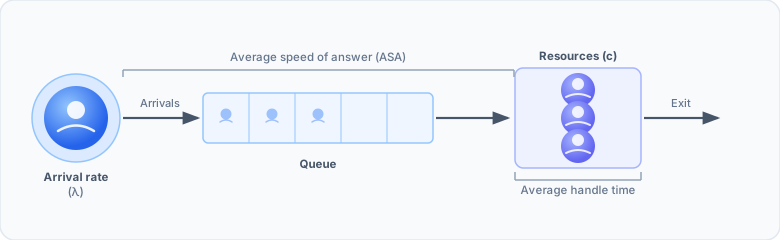
Erlang C represents the system as a queue with these assumptions:
- arrivals follow a Poisson process with a constant rate;
- each resource handles one transaction at a time;
- there is a fixed number of positions available in the interval;
- when all positions are busy, transactions wait in an infinite queue;
- handling times follow an exponential distribution;
- there is no abandonment — nobody leaves the queue.
Key terms
| Term | Meaning |
|---|---|
| Transactions | Number of incoming requests in the interval |
| Arrival rate | Transactions per unit of time |
| AHT | Average handle time — time a resource spends on one transaction |
| ASA | Average speed of answer — target waiting time before handling starts |
| Shrinkage | Fraction of time a resource is unavailable (breaks, training, …) |
| Occupancy | Fraction of time a resource is actually handling transactions |
| Service level | Fraction of transactions answered within the ASA target |
The traffic intensity (offered load, in Erlangs) is
$$ A = \frac{\text{transactions}}{\text{interval}} \times \text{AHT} $$
and is available as the intensity attribute.
Basic usage
from pyworkforce.queuing import ErlangC

erlang = ErlangC(transactions=100, asa=20 / 60, aht=3, interval=30, shrinkage=0.3)

requirements = erlang.required_positions(service_level=0.8, max_occupancy=0.85){'raw_positions': 14,
'positions': 20,
'service_level': 0.8883500191794669,
'occupancy': 0.7142857142857143,
'waiting_probability': 0.1741319335950498}Units
asa, aht and interval must all use the same time unit. In the example above everything is in minutes, so a 20-second ASA target is 20 / 60.
What the result means
raw_positions— productive positions required before shrinkage.positions— positions to staff after accounting for shrinkage,ceil(raw_positions / (1 - shrinkage)).service_level— the achieved service level atraw_positions.occupancy— achieved occupancy, capped bymax_occupancy.waiting_probability— probability an arriving transaction waits.
Evaluating a fixed number of positions
Besides sizing the team, you can evaluate metrics for a given number of positions:
erlang.waiting_probability(positions=20)   # P(wait)
erlang.service_level(positions=20)         # achieved service level
erlang.achieved_occupancy(positions=20)    # occupancy
If your positions figure already includes shrinkage, pass scale_positions=True so the productive positions are derived from it:
erlang.service_level(positions=20, scale_positions=True)Inspecting the estimator
Like a scikit-learn estimator, ErlangC has a readable repr and get_params():
>>> erlang
ErlangC(transactions=100, aht=3, asa=0.333..., interval=30, shrinkage=0.3)
>>> erlang.get_params()
{'transactions': 100, 'aht': 3, 'asa': 0.333..., 'interval': 30, 'shrinkage': 0.3}
When Erlang C is not enough
Erlang C assumes nobody ever hangs up, which makes it conservative: it tends to over-staff because, in reality, some customers abandon the queue. If abandonment matters for your operation, use the Erlang A model.
Common pitfalls
- Keep
asa,ahtandintervalin the same unit. - Do not treat
positionsandraw_positionsas interchangeable:positionsincludes shrinkage. - Erlang C requires enough productive positions for system stability. If demand is too high for a proposed position count, increase positions or use
required_positions. - Use Erlang A when customer abandonment is a major part of the operation.