Erlang A (abandonment)
Erlang C assumes customers wait forever. In real contact centers, people hang up if they wait too long. The Erlang A model (the M/M/c+M queue) adds an abandonment — or patience — rate: each waiting customer leaves after an exponentially distributed patience time with mean patience.
Because some customers abandon, Erlang A typically needs fewer agents than Erlang C for the same service level.
How it is computed
pyworkforce computes every Erlang A metric exactly from the stationary distribution of the underlying birth-death Markov chain — there are no closed-form approximations. The chain has:
- birth rate $\lambda$ (arrival rate);
- death rate $\min(n, c),\mu + \max(n - c, 0),\theta$ in state $n$,
where $c$ is the number of servers, $\mu = 1/\text{AHT}$ the service rate and $\theta = 1/\text{patience}$ the abandonment rate. Abandonment keeps the queue finite, so the system is stable for any load.
Sanity check
As patience grows large (infinitely patient customers) the Erlang A metrics converge to the Erlang C results. pyworkforce's test suite verifies this, and also checks the analytic metrics against a Monte Carlo simulation.
The queue system
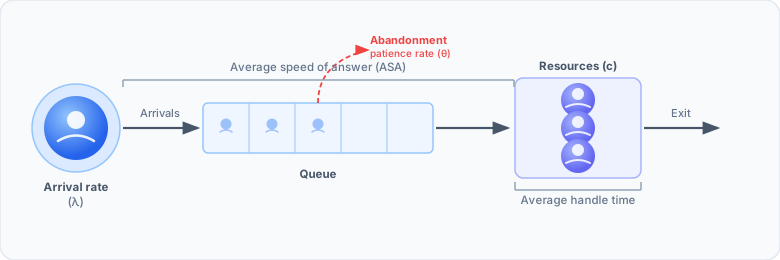
Callers who wait beyond their patience leave the queue (dashed red arrow). The system remains stable at any load because abandonments prevent unlimited queue growth.
Basic usage
from pyworkforce.queuing import ErlangA

erlang = ErlangA(transactions=100, aht=3, asa=20 / 60,
                 interval=30, patience=5, shrinkage=0.3)

print(erlang.required_positions(service_level=0.8,
                                max_occupancy=0.85,
max_abandonment=0.05)){'raw_positions': 13,
'positions': 19,
'service_level': 0.858...,
'occupancy': 0.750...,
'abandonment_probability': 0.025...,
'waiting_probability': 0.226...,
'average_speed_of_answer': 0.125...}required_positions finds the smallest number of positions that meets all of the targets you set: the service level, the maximum occupancy and the maximum abandonment probability.
Per-position metrics
For a fixed number of positions you can read each metric directly:
erlang.waiting_probability(positions=14)       # P(delayed)
erlang.abandonment_probability(positions=14)   # P(customer abandons)
erlang.achieved_occupancy(positions=14)        # server utilization
erlang.average_speed_of_answer(positions=14)   # expected wait (minutes)
erlang.average_queue_length(positions=14)      # expected number waiting
erlang.service_level(positions=14)             # answered within asa
You can override the answer-time target per call:
erlang.service_level(positions=14, asa=30 / 60)Parameters
| Parameter | Meaning |
|---|---|
transactions | Arrivals in the interval |
aht | Average handle time |
asa | Target answer time (default service-level threshold) |
interval | Interval length |
patience | Mean time a customer waits before abandoning |
shrinkage | Fraction of unavailable time, in [0, 1) |
asa, aht, interval and patience must share the same time unit.
Erlang C vs Erlang A
| Erlang C | Erlang A | |
|---|---|---|
| Customers abandon? | No | Yes |
| Tends to | over-staff | realistic staffing |
| Extra parameter | — | patience |
| Extra outputs | — | abandonment probability, queue length |
Use Erlang A when abandonment is material to your operation, and Erlang C as a conservative baseline.