Erlang C in Python for Call Center Staffing
Erlang C estimates how many agents a call center needs to meet a target wait time when callers stay in the queue. In the Python example, 100 calls in 30 minutes with a three-minute average handle time need 14 productive agents to meet an 80% in 20 seconds target and an 85% occupancy limit. At 30% shrinkage, schedule 20 agents so enough are available to take calls.
The queue system
Erlang C represents the system as a queue with these assumptions:
- arrivals follow a Poisson process with a constant rate;
- each resource handles one transaction at a time;
- there is a fixed number of positions available in the interval;
- when all positions are busy, transactions wait in an infinite queue;
- handling times follow an exponential distribution;
- there is no abandonment — nobody leaves the queue.
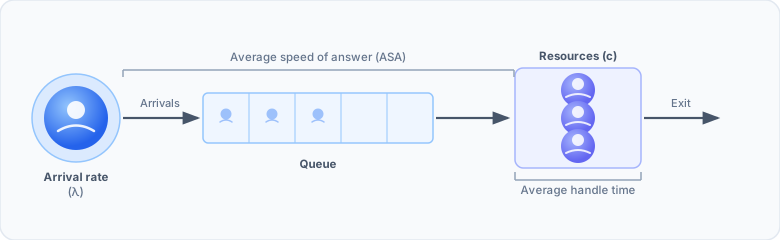
Key terms
| Term | Meaning |
|---|---|
| Transactions | Number of incoming requests in the interval |
| Arrival rate | Transactions per unit of time |
| AHT | Average handle time — time a resource spends on one transaction |
| ASA | Average speed of answer — target waiting time before handling starts |
| Shrinkage | Fraction of time a resource is unavailable (breaks, training, …) |
| Occupancy | Fraction of time a resource is actually handling transactions |
| Service level | Fraction of transactions answered within the ASA target |
The traffic intensity (offered load, in Erlangs) is
$$ A = \frac{\text{transactions}}{\text{interval}} \times \text{AHT} $$
and is available as the intensity attribute.
Basic usage
from pyworkforce.queuing import ErlangC

erlang = ErlangC(transactions=100, asa=20 / 60, aht=3, interval=30, shrinkage=0.3)

requirements = erlang.required_positions(service_level=0.8, max_occupancy=0.85){'raw_positions': 14,
'positions': 20,
'service_level': 0.8883500191794669,
'occupancy': 0.7142857142857143,
'waiting_probability': 0.1741319335950498}Units
asa, aht and interval must all use the same time unit. In the example above everything is in minutes, so a 20-second ASA target is 20 / 60.
What the result means
raw_positions— productive positions required before shrinkage.positions— positions to staff after accounting for shrinkage,ceil(raw_positions / (1 - shrinkage)).service_level— the achieved service level atraw_positions.occupancy— achieved occupancy, capped bymax_occupancy.waiting_probability— probability an arriving transaction waits.
Evaluating a fixed number of positions
Use the staffing curve tutorial to compare candidate headcounts against service and occupancy targets in one table and figure.
Besides sizing the team, you can evaluate metrics for a given number of positions:
erlang.waiting_probability(positions=20)   # P(wait)
erlang.service_level(positions=20)         # achieved service level
erlang.achieved_occupancy(positions=20)    # occupancy
If your positions figure already includes shrinkage, pass scale_positions=True so the productive positions are derived from it:
erlang.service_level(positions=20, scale_positions=True)Inspecting the estimator
Like a scikit-learn estimator, ErlangC has a readable repr and get_params():
>>> erlang
ErlangC(transactions=100, aht=3, asa=0.333..., interval=30, shrinkage=0.3)
>>> erlang.get_params()
{'transactions': 100, 'aht': 3, 'asa': 0.333..., 'interval': 30, 'shrinkage': 0.3}
When Erlang C is not enough
Erlang C assumes callers stay until served. If callers regularly hang up before an agent answers, the Erlang A model lets you model their patience and estimate abandonment alongside staffing.
Common pitfalls
- Keep
asa,ahtandintervalin the same unit. - Do not treat
positionsandraw_positionsas interchangeable:positionsincludes shrinkage. - Erlang C requires enough productive positions for system stability. If demand is too high for a proposed position count, increase positions or use
required_positions. - Use Erlang A when customer abandonment is a major part of the operation.